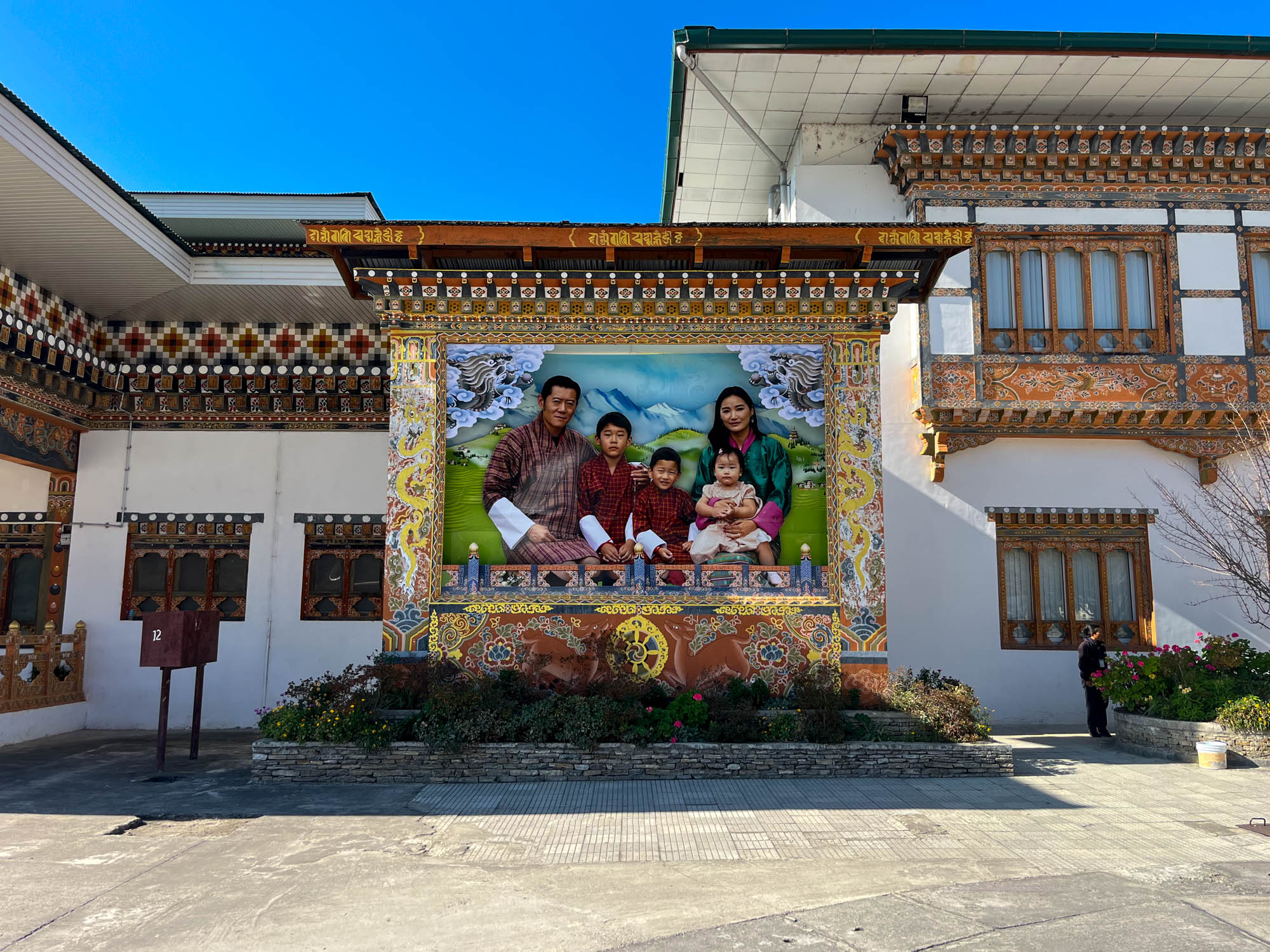
The King of Bhutan, known as the Druk Gyalpo (Dragon King), holds a unique position that combines constitutional authority with deep moral and symbolic leadership. The current king, Jigme Khesar Namgyel Wangchuck, the fifth Druk Gyalpo, ascended the throne in 2006 after his father voluntarily abdicated in his favor (in general, Bhutanese kings step down when they reach age of 65). Educated in Bhutan, the United States, and the United Kingdom, the king is widely respected for his humility, accessibility, and close engagement with citizens across the country. The King regularly attends (and participates) in religious festivals (tsechus), national holidays such as National Day (17 December) and important cultural and civic events across the country. Unlike many monarchs, he often travels to remote villages and districts, joining local ceremoniesand interacting directly with people rather than remaining distant or ceremonial.
From the 17th century, Bhutan was unified by Zhabdrung Ngawang Namgyal, a Tibetan Buddhist lama who established the foundations of the Bhutanese state. Before the establishment of the monarchy in 1907, Bhutan was not ruled by kings but by a theocratic and regional power structure shaped by Buddhism and local authority. The history of Bhutan’s kings is therefore relatively recent but deeply influential in shaping the modern Bhutan. The Wangchuck dynasty was established in 1907, when Ugyen Wangchuck was elected as Bhutan’s first hereditary king (Druk Gyalpo), unifying the country after a period of internal conflict and regional fragmentation.
- Ugyen Wangchuck (b.1861–d.1926) “First King”; reigned 17 December 1907 – 21 August 1926.
- Jigme Wangchuck (b.1905–d.1952) “Second King”; r. 21 August 1926 – 24 March 1952.
- Jigme Dorji Wangchuck (b.1929–d.1972) “Third King”; r. 24 March 1952 – 24 July 1972.
- Jigme Singye Wangchuck (b.1955) “Fourth King”; r. 24 July 1972 – 9 December 2006.
- Jigme Khesar Namgyel Wangchuck (b.1980) “Fifth King”; r. 9 December 2006 – present.
Bhutan’s royal family has since played a central role in guiding Bhutan’s carefully managed modernization. Under the leadership of successive kings, Bhutan introduced major reforms, including the gradual transition from absolute monarchy to a constitutional monarchy and the introduction of democratic elections. The royal family has consistently emphasized national unity, cultural preservation, environmental protection, and the development philosophy of Gross National Happiness, which prioritizes collective well-being over purely economic growth.
Beyond their constitutional and political roles, the king and the royal family are deeply woven into Bhutanese society and everyday life. Members of the royal family are widely admired for their service-oriented approach, personal modesty, and strong connection to Bhutanese traditions and Buddhism. The Queen – Jetsun Pema Wangchuck (Gyaltsuen) and other royal family members are actively involved in social causes such as education, healthcare, and youth development, reinforcing the monarchy’s role as a unifying and stabilizing force in Bhutan’s social and cultural landscape.
Criticism of the King of Bhutan is very limited and indirect, reflecting both deep public respect for the monarchy and cultural sensitivity toward open dissent, but some recurring concerns do emerge. For example concentration of informal power in the monarchy despite Bhutan’s constitutional framework, which can blur accountability and constrain open political debate. Economic challenges are quite visible—particularly youth unemployment, outward migration, and limited private-sector opportunities. The philosophy of Gross National Happiness is sometimes criticized for masking structural issues such as inequality, governance weaknesses, and mental health concerns, while restrictions on media and public discourse are seen by some as limiting freedom of expression. Importantly, these critiques target institutional structures and policy choices rather than the current king personally, who remains widely respected.