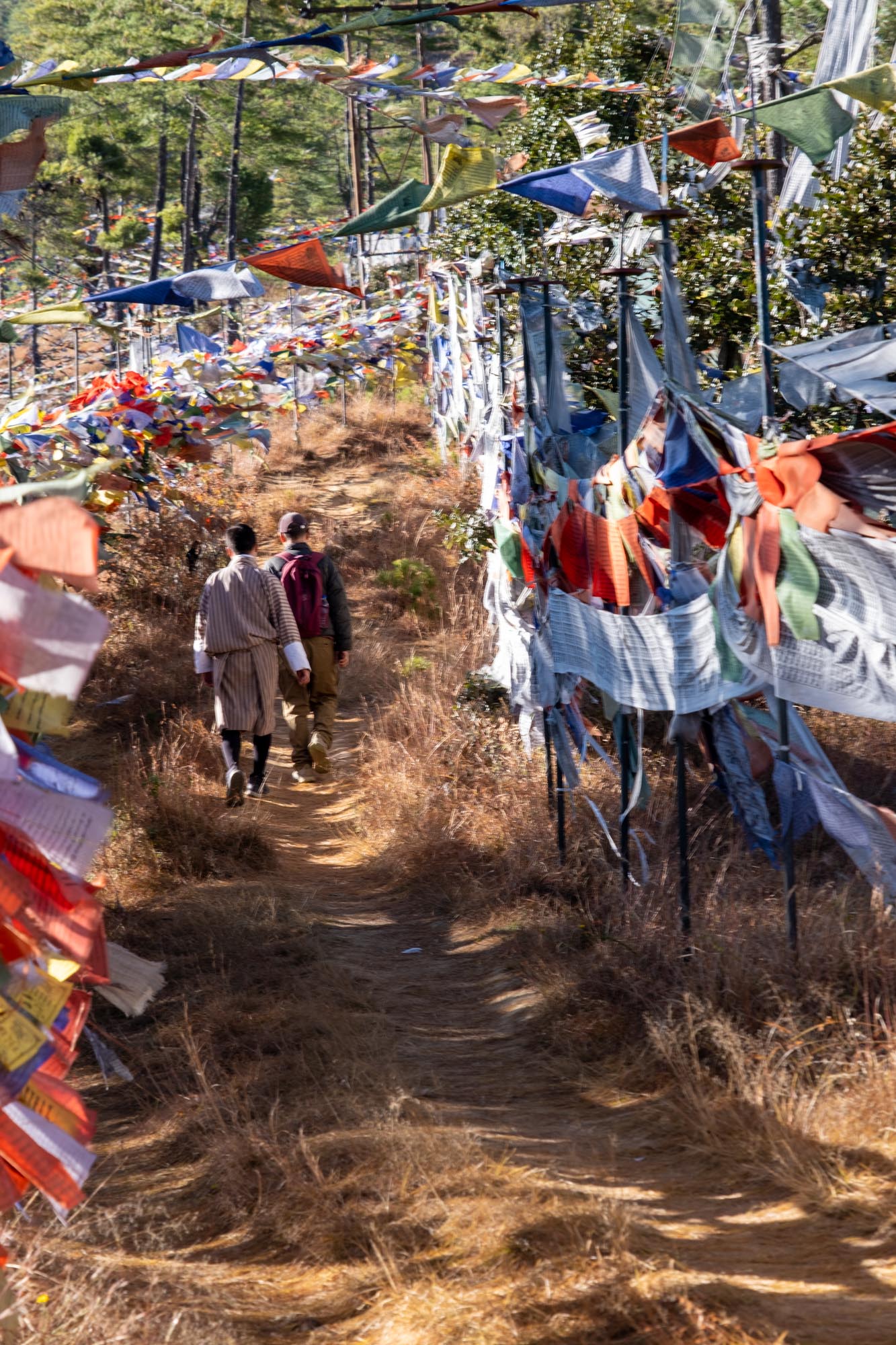
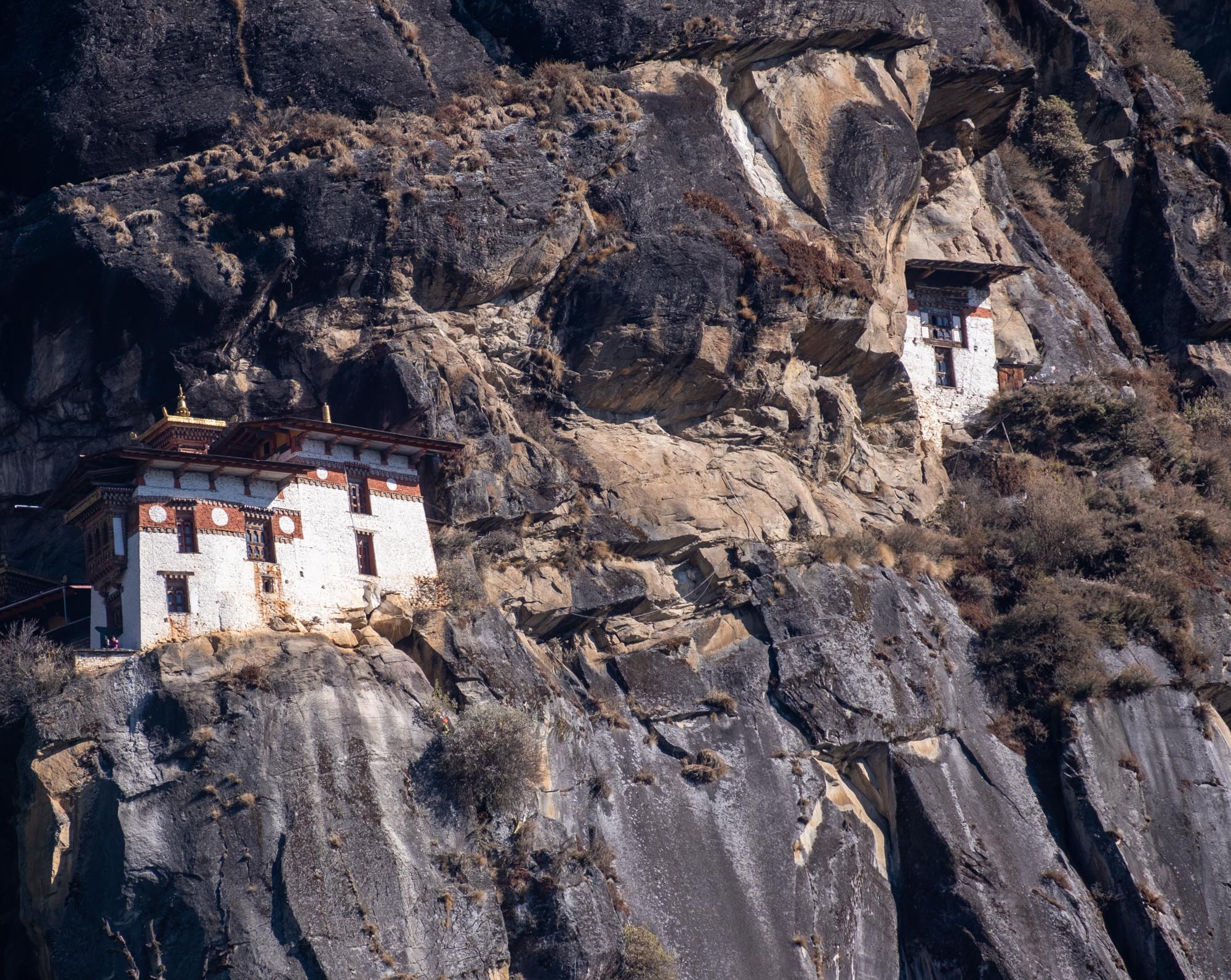
I admit. Bhutan enchanted me with its authentic culture, unspoiled nature, and the energy you feel the moment you arrive. Every valley, every dzong and temple has its own story. Walking through the streets of Thimphu or going for a morning run along the river, accompanied by barking dogs and the early sun, was an experience in itself. Visiting Tiger’s Nest was inspiring—the trek, the climbs, and the views of the cliffside monastery, together with crowds of locals (and, of course, tourists), create a feeling of being part of something greater and deeply spiritual. At the same time, after a week and many kilometers on the road, I may have simply needed some activity—movement that loosened both body and mind. Not to mention those moments at Chele-la pass, the kindness of local women, and the prayers of young monks.
Culinarily, Bhutan did not particularly impress me, although the simple yet very intense food is a reminder that life in the mountains is closely tied to nature, seasonal produce, and tradition. Their chili paste, however, is excellent—spicy but full of flavor—and a great addition to many dishes. The people are very friendly and approachable, even toward us, intrusive tourists. Altogether, it gives the impression that tourism has not taken over, but that visitors simply fit into the rhythm of life in the valleys. Overall, it is a calm and authentic destination.
At the same time, much of this unspoiled character and authenticity is also a result of the country’s limited openness to visitors, namely the so-called Sustainable Development Fee. Bhutan’s position is that this fee is essential for preserving its unique culture, pristine nature, and a high-quality tourism model with low visitor numbers (high value – low impact). The fee (supposedly) finances education, healthcare, and infrastructure, ensuring that the benefits reach citizens, although there are ongoing internal debates and adjustments (such as fee reductions and incentives) to balance sustainability with economic recovery and the challenges faced by some tourism businesses. The government sees it as an investment in the future and a way for visitors to contribute in a “meaningful” way. Our guide also believed that Bhutan should nonetheless open up to more tourists, which could benefit the local economy. At the same time, the fact that there are no hordes of tourists and massive crowds is currently part of the country’s appeal—it is not India or neighboring Nepal. And my opinion on the tourist tax? I’m not against it. While it makes the country financially inaccessible to many travelers, it also ensures that Bhutan remains an “exclusive” destination without mass tourism. This is admittedly a very selfish view, since greater openness would also mean more visitors and, consequently, higher revenues for the local economy.
As for costs… one week in Bhutan, in a group, including the tourism fee and flights from regional hubs (such as Delhi, Dubai, or Bangkok), will cost you at least around EUR 2,500. This includes basic services, without any luxury—prices can rise very quickly at the higher end. For one week in December, the fee currently amounts to USD 700 (USD 100 per day), on top of which come accommodation, transport, and a guide—so Bhutan is not a budget destination. The infrastructure also does not really allow for large tourist groups, which I personally found very appealing. Air connections to major hubs are limited as well, since only local carriers are allowed to land in Bhutan. Independent travelers are welcome, but without a tour agency and a guide you can’t do much—and it is still quite expensive, as you need transport and a guide, and solo travelers must additionally pay around USD 40 per day. Without an agency, you probably can’t obtain a visa either (although apparently this is possible, in any case you cannot avoid having a guide). Moreover, the overall experience depends heavily on the local guide—online you can read quite a bit about intrusive guides who change the agreed “program” and take you to places where they earn commission. That said, to be fair, I never had the feeling that we ended up in a tourist trap where they tried to squeeze every last cent out of us. At least not directly 🙂 We were quite lucky with ours.
Most tourists visit western Bhutan, where Thimphu, Punakha, and Paro are the main highlights (with Tiger’s Nest practically always at the end of the itinerary), and the routes are almost all the same—long transfers along narrow roads running in both directions through the same valleys. Nearly all tourist infrastructure is concentrated around these three places. I get the impression that there is not much variability between different tour packages. Multi-day treks are, of course, a special exception, and experiencing one in this part of the Himalayas would be fantastic.
So if I were to return, I would definitely try to organize a smaller group (four people might still be financially feasible; fewer becomes much more expensive per person, while more reduces flexibility), adapt the itinerary, and perhaps travel a bit more slowly. I would certainly combine the visit with a shorter trek and overnight stays in homestays along the way. We visited the Haa Valley, which is off the tourist radar, and it was wonderful—we didn’t meet a single (!!!) tourist there, which is exactly why staying in a homestay would be great. I would also time a future visit to coincide with one of the festivals (for example, their National Day is on December 17, a week after our departure), which are surely colorful and unforgettable experiences. In any case, I am almost certain that even during peak tourist season, the sights are not overcrowded—although climbing Tiger’s Nest in a long queue would not be pleasant. Eastern Bhutan would be an experience in itself, as there are hardly any tourists at all. All of this is currently only possible if you hire an agency and a guide. Without them, you can really only walk around the surroundings of Thimphu and Paro, and even there you may be denied entry to attractions (especially temples and dzongs). I understand that this is their tourism policy—controlling and directing visitor flows and, presumably, ensuring a more “authentic” experience—but at moments (very rare moments) it felt a bit like visiting North Korea, because you always had a guide with you. The difference, of course, is that people in Bhutan are approachable and genuinely free. Happy? Also, at least they appear so. Although the country does face serious issues among young people: unemployment is high, and emigration—especially of educated professionals—is significant. The country’s isolation has consequences, and there are few entrepreneurial initiatives. Economically, Bhutan depends mainly on electricity exports (hydropower) and tourism. So this “happiness” is a double-edged sword, and life there is not all sunshine and honey… only in 2023 did Bhutan, according to UN classification, “graduate” from LDC (least developed country) status to that of a developing country./p>
And finally, the question—was it worth it? Despite the enthusiasm, the answer is still a cautious yes. On the one hand, it is very much worth visiting, as you gain genuine insight into the last Himalayan kingdom that has consciously remained quite cut off from the world. On the other hand, the obligation to hire a local agency and guide means you are locked into a relatively fixed program that follows established routes, with little room for improvisation. Still, I assume that almost anything can be arranged. 🙂